To provide emergency lifting equipment to disaster stricken areas, in order to save Lives and the Environment.
Showing posts with label Thomas Anderson. Show all posts
Showing posts with label Thomas Anderson. Show all posts
Sunday, 2 May 2010

Presentation


If anyone would like to have a look at how to assemble the crane please contact James Baddeley for a demonstartion of the model.
Wednesday, 21 April 2010
Design of components
When designing each component we took into account each of the following:
- Weight - Each component would need to be light enough for a person to carry.
- Ease of use - The whole assembly would need to be assembled and dissassembled without specialist knowledge. The assembly uses a simple idea with very few components.
- Adaptability - The crane would need to adapt to the environment it is in. If the ground is uneven, a series of holes in the beams allow for making the legs longer/shorter.
- Robustness - Each component was designed with the forces that will be acting on it in mind. The materials we have used are robust enough to hold the load.
- Cost - The cost of each component was taken into account as there is very little point in having a disaster relief crane that costs a fortune to produce. Wood is very heavy but is very cheap too, this is why we picked this material over metals.
- Size - Each component was designed to fit in or on a Land Rover. The metal components would easily fit in the back of the vehicle and the beams would be able to go on the roof rack without obstructing the drivers view or causing any hazards
- Repair - We used wood for the beams because they are easily replaced with a material that may be in the disaster area without the need for specialist tools. The beams would be under the most stress so therefore we made these replacable. If a joint was to break then a replacement would be needed and for this reason we have chosen to use steel to decrease the chance of damage.
CAD Design and Rendered Image
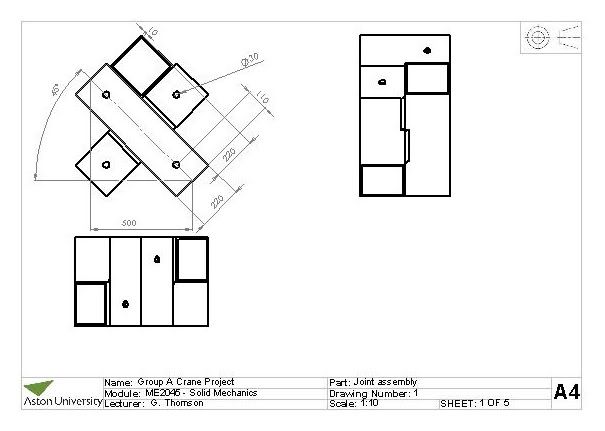
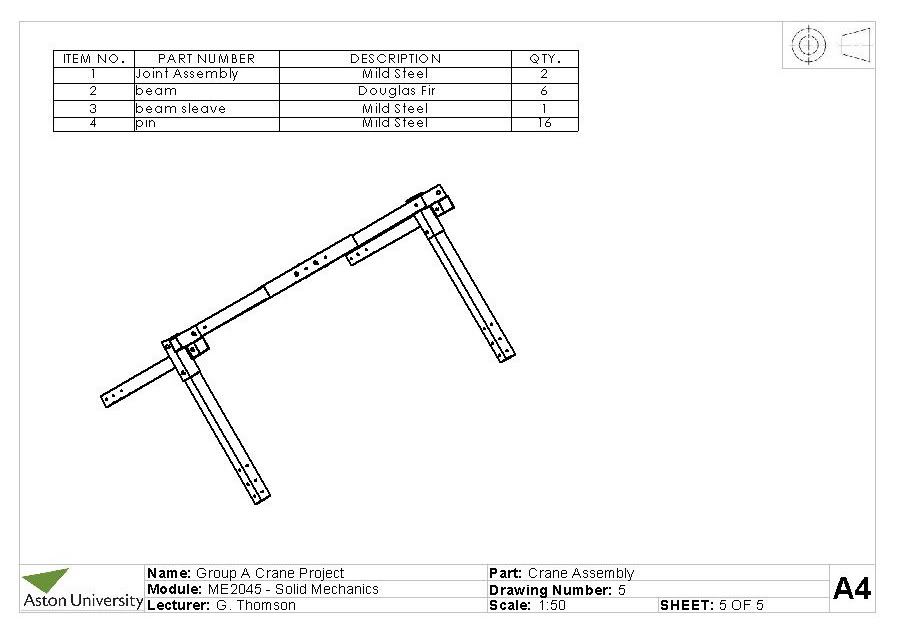
We designed our final crane design in Solidworks and produced some engineering drawings which are below:


This is a rendered image of what the crane will look like:



This is a rendered image of what the crane will look like:
Idea Evaluation
Whilst evaluating the idea we noticed that the lifting arm wasn't long enough to lift the load without substantially more force. Without a longer arm the current idea would require more force with the crane than without. With a longer arm we can use the principles of leverage to the point where 1 or 2 people can lift the load without the need for weights. This would make the design cheaper and more effective.
Sunday, 21 March 2010

Friday, 19 March 2010
19/3/10 Minutes
Attendees
Mohammed Altubayieb
Thomas Anderson
James Baddeley
Richard Bay
Tasks Achieved
Mohammed Altubayieb
Thomas Anderson
James Baddeley
Richard Bay
Tasks Achieved
- Initial Brainstorming complete. Research on different types of crane, counterbalancing methods and movement methods.
- Individual ideas discussed.
- Evaluated different designs.
Tasks to be completed by 22/3/10
- Individual ideas and diagrams to be uploaded on blog by team members.
- Research page to be uploaded.
- Fully design chosen idea
Next meeting at 5PM 22/3/10
Tuesday, 9 March 2010
First Meeting 8.3.10
Position allocation:
Project Manager: Peter Armstrong armstpwa@aston.ac.uk
Finance Officer: James Baddeley baddeljc@aston.ac.uk
Chief Designer: Thomas Anderson andersot@aston.ac.uk
Materials Specialist: Richard Bay bayrh@aston.ac.uk
Stress Analyst: Mohammed Altubayieb altubaym.ac.uk
Project Manager: Peter Armstrong armstpwa@aston.ac.uk
Finance Officer: James Baddeley baddeljc@aston.ac.uk
Chief Designer: Thomas Anderson andersot@aston.ac.uk
Materials Specialist: Richard Bay bayrh@aston.ac.uk
Stress Analyst: Mohammed Altubayieb altubaym.ac.uk
Subscribe to:
Posts (Atom)